


Have you ever thought about signing up for a 5K race and then backed out because you thought you were “not a runner”? Let us reassure you: most women standing at the start line of their first race had not run a single minute two months earlier. First 5K training for beginners does not need exceptional fitness or expensive gear, only a clear plan, patience and clothes that give you comfort and coverage together, and this is what we make at A&B, modest activewear for women, so you can think about your next step and not about what you are wearing.
In this guide we walk with you for eight weeks, from your first minute of running to the finish line. We explain the plan week by week, talk about heat and recovery, then give a whole section to the question every modest athlete asks: what do I wear? Here we speak as the people who design these clothes, because we are A&B, and we design our collection in Jeddah to suit hot weather.
Why is 5K the best place to start?
It is the most popular distance for a first race, for good reasons. It is long enough to give you a real sense of achievement, short enough to reach within two months without excessive strain, and many community races welcome people who combine walking and running, so there is no pressure on someone who is just starting.
Most importantly, your goal in the first race is not time. Your goal is to finish the distance smiling and to leave the finish line wanting more. Make that your only measure, and you will see fear turn into excitement.
Before you start, watch for four simple things
- Consult your doctor if you have a health condition or a previous injury, or if you have been inactive for a long time.
- Choose comfortable running shoes, try them on late in the day when your feet swell slightly, and make sure your toes move freely.
- Set the race date and count eight weeks back. Having a fixed date turns intention into commitment.
- Stick to three sessions a week with at least one rest day between them. The body gets stronger during rest, not only while running.
Eight-week plan for first 5K training for beginners
The plan alternates between running and walking, which is the gentlest approach on the joints and the most successful with beginners. Every session starts with five minutes of brisk walking to warm up and ends with five minutes of easy walking with light stretching. The numbers below are for the main part of the session, which you repeat in all three sessions.
- Week 1: run for one minute, then walk for two minutes, and repeat eight times.
- Week 2: run for two minutes and walk for two minutes, five times.
- Week 3: run for three minutes and walk for two minutes, four times.
- Week 4: run for five minutes and walk for two minutes, three times.
- Week 5: run for eight minutes and walk for two minutes, then run another eight minutes.
- Week 6: run for ten minutes and walk for one minute, then run another ten minutes.
- Week 7: run twenty minutes without stopping in the second session, and ease the other two sessions with the Week 6 pattern.
- Week 8: race week. A calm twenty-minute session at the start of the week, then a light fifteen-minute session two days before the race, then complete rest the day before.
What does your typical week look like?
To make it easier to stick with, we suggest a simple layout that you can adjust to your schedule:
- Saturday: the first session of the plan (running and walking).
- Sunday: complete rest, or an easy twenty-minute walk.
- Monday: the second session of the plan.
- Tuesday: ten minutes of strength exercises, then rest.
- Wednesday: the third session, the longest of the three.
- Thursday: strength exercises again with gentle stretching.
- Friday: rest, or a walk with someone you love.
The idea is not to have two running sessions on consecutive days, so your muscles get a full day to recover between sessions. If dawn suits you, choose the same time every time, because a habit forms through repetition at the same time more than through enthusiasm alone.
What your body needs between sessions
Running in the heat
Running in hot weather is a real challenge, so choose a cooler time: dawn or after sunset. Drink water throughout the day, not only before the session, and if humidity is high, shorten the session and slow down.
Watch for warning signs: dizziness, nausea or suddenly stopping sweating. If they appear, stop immediately and give your body time to settle.
Recovery and nutrition
Recovery rests on three pillars: enough sleep, a meal combining protein and carbohydrates after the session, and light stretching. General muscle soreness after the first sessions is normal, but do not ignore sharp pain in the knee or ankle, as it calls for rest and possibly consulting a specialist.
You do not need a special diet for a 5K. It is enough to eat balanced meals that combine complex carbohydrates such as rice, oats and brown bread with protein such as eggs, chicken and legumes. An hour or two before a session, have a light snack such as a banana or a slice of bread with honey, and avoid heavy foods right before running.
Warm-up and stretching
Many beginners set off suddenly and their muscles tighten in the first minutes, so make sure to do a dynamic warm-up before every session: raise your knees alternately for thirty seconds, then move your ankles and hips in wide circles, then do ten light squats.
After the session, hold each stretch for thirty seconds without bouncing, and focus on the thigh, calf and hip muscles. A correct stretch is comfortable, not painful, so if you feel sharp pain, ease the stretch immediately.
What should you wear? A guide to modest running clothes
The right clothes make a real difference, so you are not adjusting your hijab every minute or feeling self-conscious in a tight piece. For first 5K training for beginners, we suggest the following from the A&B collection that we design in Jeddah:
- Tops: if you want more coverage, a Longline Oversized Parka is a practical choice, and for lighter days the V-Neck Performance Top.
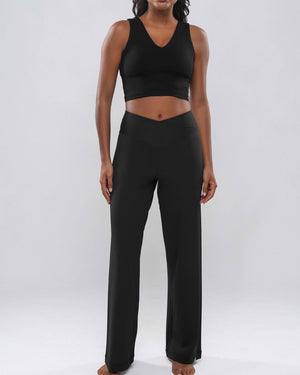
- Bottoms: the Crossover Waist Leggings with a close fit, available in Olive Green among other colours, and if you prefer a loose cut, the Modest Wide-Leg Training Pants give your legs freedom of movement.
- Hijab and head: a hijab that slips is distracting, which is why we offer the Bamboo Sports Hijab Scarf. The Bamboo Sports Headband is worn under the hijab as a grip layer, and it is not a hijab.
- Outer layer: it can be cool at the start line on early winter mornings, and the Longline Oversized Parka is a light layer you wear while waiting and take off before you set off.
- After the finish line: the Statement Denim Bag, designed by us in Saudi Arabia, is good for carrying your things while you celebrate your achievement.
Before ordering, check the size guide, and remember a golden rule: do not wear anything new on race day, and try your clothes in training sessions at least two or three times.
If you like ready-made styling, browse the “Sets” page on our site to build your set, and we also have collections for gym wear, everyday activities and travel for after the race. Before ordering, check the size guide and the care guide, review the shipping and returns policy, and remember a golden rule: do not wear anything new on race day, and try your clothes in training sessions at least two or three times.
Race bag and race day
We like you to arrive at the start line calm and not searching for anything, so prepare these items the day before the race:

- Your full race outfit, with an extra layer if the morning is cold.
- The running shoes you trained in, not new shoes.
- Your race number and its pins if needed.
- A small water bottle and a light snack for after the race.
- A spare hijab or headband, a small towel and clean clothes to change into.
- Your phone and ID card, and your headphones if you like running to music.
On race day:
- Prepare everything the night before: clothes, shoes, number, water and your keys.
- Have your usual light meal about two hours before the race, and do not try a new food.
- Arrive early to avoid stress, and warm up with five minutes of brisk walking.
- Start slower than you think: the biggest mistake in a first race is setting off fast and draining your energy before the third kilometre.
- Split the distance mentally: two kilometres to settle in, two kilometres to hold steady, and a final kilometre with everything you have left.
- Walking is not defeat: take a walking break when you need one, then return to running.
After the finish line, change out of wet clothes quickly, drink water, then celebrate what you achieved, whatever your time.

How do you keep going and avoid common mistakes?
Week three is often the hardest in first 5K training for beginners, as the excitement of the start has faded and results have not yet shown, and three small tricks make a difference:
- Run with a friend or join a group, because commitment to another person is hard to ignore.
- Log your sessions in a notebook or an app and review them when your resolve weakens, and you will be surprised at how far you have come.
- Reward yourself after every week you finish with something you love.

And remember that a short session is better than a cancelled one, as even ten minutes of running and walking keeps the habit alive, and avoid these common mistakes:
- Increasing effort too fast. It is always better to progress gradually.
- Skipping rest days thinking they slow progress, when they are actually part of progress.
- Comparing yourself with others, as every body has its own rhythm.
- Ignoring sharp pain, or neglecting water in hot weather.
Frequently asked questions
Can I walk during the race? Yes, and most beginners do. What matters is that you finish the distance.
How long does the distance take? The time differs from one woman to another, and many beginners finish the distance in between thirty and fifty minutes. Do not let the number occupy you.
What if I miss a whole week of training? Repeat the week before it and then carry on, and if little time remains, do not worry: the last week is for easing off more than building.
Do I need special clothes for running? Not necessarily, but pieces designed for movement, ventilation and coverage, like what we make at A&B, give you more comfort and remove the distraction of the hijab, the sleeves and the length of the top.
Should I run every day to progress faster? No. Three sessions a week are enough for a beginner, because rest is an essential part of training, and increasing effort too quickly is the shortest road to injury.
Should I run on a treadmill or outside? Both work. The treadmill gives you cool conditions and a steady rhythm in the heat, while outside gets you used to the real race ground, so try running outside at least once a week during the final weeks.
Start your 5K journey with one minute of running and an achievement you will be proud of
First 5K training for beginners is an eight-week journey that starts with a single minute of running and ends with an achievement you will be proud of. Progress gradually, give your body the rest it deserves, avoid the midday heat, and choose clothes that make you feel comfortable and confident with every step. If you want to start with ready-made pieces for your first race, our full collection at A&B is waiting for you, designed in Jeddah so you can stand on the start line with confidence. And now, sign up for the race, lace up your shoes, and start with one minute today.